


 Log in
Biofixes
Several models need field information to perform correct simulations: These adjustments to the real phenology in the field are called BIOFIX.
You need to provide this information for the main variety at the location.
Apple and pear
Tree phenology
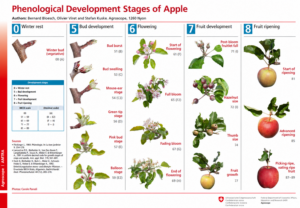
Biofixes Used in RIMpro
A biofix is a biological reference point used to initiate disease or pest development models in RIMpro. Choosing an accurate biofix is essential because it determines the starting point for all subsequent calculations and forecasts. Different RIMpro models use different biological events as biofixes, depending on the pathogen or pest being monitored.
Apple Scab Model
For the apple scab model, the biofix is defined as the first dischargeable ascospores of Venturia inaequalis. RIMpro uses this event to begin calculations of ascospore maturation and infection risk throughout the season.
The recommended methods for determining the biofix, in order of reliability, are:
- First ascospore ejection under laboratory conditions from freshly collected infected leaves.
This is considered the most accurate method. - First spores detected in field spore traps.
This method is practical but often identifies the biofix slightly too late. - First morphologically mature spores (approximately 10%) observed under the microscope.
This approach tends to estimate the biofix somewhat too early. - First green tip stage (around 10%) on the main apple variety.
This recommendation is based on the historical co-evolution between apple trees and the apple scab pathogen.
In practice, the biofix should be set to the earliest occurrence of either:
- the first ascospore discharge, or
- the green tip stage.
RIMpro also includes a “Biofix Prediction” tool. However, this feature is mainly reliable in regions with mild winters and limited snow cover, where climatic conditions allow more consistent biological development.
Apple Sawfly Model
For apple sawfly, the model automatically estimates the beginning of adult flight. However, since pupation takes place in the soil, local soil microclimate conditions may differ from standard air temperature measurements used by the weather station. Therefore, the user may optionally define a custom biofix. The biofix is based on the first captures of apple sawfly adults on white sticky traps in the region. These first captures mark the onset of adult emergence and are used to initialize the model simulations.
Codling Moth Model
For codling moth, the start of flight is automatically calculated. However, you can set a biofix if the captures are significant and occur before the model predicts the natural beginning of the flight period.
It is important to remember that pheromone traps capture only male moths, whereas RIMpro models the development and activity of females, which are directly related to egg laying and damage risk. Since males generally emerge slightly earlier than females, isolated early captures should be interpreted cautiously.
Apple Canker Model
In the apple canker model, the biofix is linked to events causing tree wounds or trauma, such as:
- harvest operations,
- pruning,
- hailstorms,
- or other severe injuries to the tree.
RIMpro allows the user to enter up to two trauma dates. For each event, the model estimates the wound healing period and calculates how long the tissues remain susceptible to canker infection. The upper graph in the model output visualizes the progressive reduction in susceptibility as healing progresses.
Stone fruits
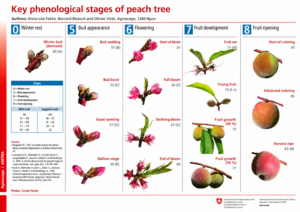
For stone fruits, it is possible to define up to three different phenological “profiles”: early-maturing, mid-season, and late-maturing. These profiles may represent different maturity groups within the same species (for example, three peach cultivars), or different stone fruit species altogether, such as one plum, one peach, and one apricot profile.
Each profile is characterized by the following key phenological reference points:
- BBCH 10 – first leaves emerging
- BBCH 60 – first flowers open
- BBCH87 – fruit ripe for picking
- Growing days number of days between bloom and harvest (calculated automatically)
Vine
The grape pest and disease models in RIMpro require accurate phenological information to correctly simulate the development of pathogens, pests, and host susceptibility throughout the season. Enter the dates at which key growth stages are reached for your main grape variety.
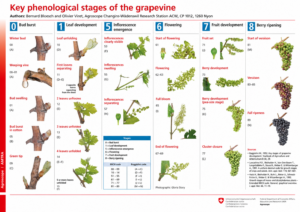
Key Phenological Stages
Start of Vegetation (BBCH 11)
This stage corresponds to the emergence of the first unfolded leaves and marks the beginning of active vine growth after winter dormancy. It is used as the biological starting point for several RIMpro models, particularly those linked to early-season pest and disease development.
Start of Flowering (BBCH 61)
BBCH 61 is reached when the first flower caps detach and the first flowers open. This stage is critical because it marks the beginning of berry susceptibility for several important grape diseases. RIMpro uses this information to estimate the duration of susceptible periods .
Fully Ripe Berries (BBCH 89)
At this stage, berries have reached full maturity and are considered ready for harvest. In RIMpro, this information is mainly used in the irrigation model to adapt water balance calculations and late-season vine water requirements.
Beginning of Leaf Fall (BBCH 93)
The beginning of leaf fall indicates the transition from active growth to vine dormancy. Leaves start yellowing and naturally dropping from the canopy. In RIMpro, this stage is also primarily used by the irrigation model, as vine water consumption decreases significantly during senescence and post-harvest physiological activity.
Microclimate Adjustments
Microclimatic conditions within a vineyard may differ significantly from those recorded at the weather station used by RIMpro. Variations in canopy density, slope, airflow, soil moisture, or proximity to vegetation can locally increase or decrease relative humidity and leaf wetness duration.
To account for these differences, RIMpro allows users to apply a microclimate correction by slightly increasing or decreasing the relative air humidity recorded by the weather station. This adjustment influences all model processes that depend on humidity, such as infection risk, sporulation, and disease development.
Microclimate Compared to Weather Station Conditions
- Less humid
- Similar to weather station
- More humid
Susceptibility of the Grape Variety
Most traditional European grape varieties are highly susceptible to downy mildew. In less susceptible or more robust varieties, infection efficiency is lower and, under the same sporulation conditions, fewer secondary spores are produced. As a result, disease development progresses more slowly on tolerant varieties.
RIMpro allows users to adapt the model according to the susceptibility level of the cultivated grape variety. This setting influences both infection efficiency and sporulation intensity within the model calculations.
Variety Susceptibility Levels
- High susceptibility (default)
- Reduced susceptibility
- Low susceptibility / robust varieties
Biofixes
Grapevine Moth Model
For grapevine moths, the beginning of adult flight is automatically estimated by the model. However, users may define a custom biofix when pheromone trap captures are significant and occur before the model predicts the natural onset of the flight period.
Because pheromone traps capture male moths only, isolated early catches should be interpreted carefully. A manual biofix is recommended only when captures clearly indicate the effective start of population activity in the vineyard.
Powdery Mildew Model
In the grape powdery mildew (oidium) model, primary infection depends on rainfall and leaf wetness conditions. When weather station data contain gaps or missing rainfall measurements, the model may not be able to calculate the primary infection correctly. In such cases, secondary infection calculations for the remainder of the season may also become unreliable.
To overcome this issue, RIMpro allows users to manually impose a primary infection date.
The model normally calculates the timing of ascospore release from cleistothecia based on suitable weather conditions. However, in vineyards with high levels of flag shoot symptoms, users may also enter the observed date of the first flag symptoms as the primary infection date.