
 Log in
What are the key variables in the irrigation model?
Parameters in the “Fields” table
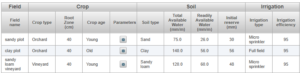
Field Name
The name of the plot selected by the user.
Crop Type
Select orchard or vineyard depending on your crop. This choice affects the threshold for available water: 40% of TAW for vineyards and 50% of TAW for orchards.
Root Zone (cm)
The rooting depth of the crop (fruit tree or vine).
Crop Age
The age of the crop. Select “young” for plots where the root system is not yet fully developed (typically < 4 years for an orchard).
Parameters
Click this button to adjust the plot parameters (dimensions/area). See explanations below
Soil Type
Select the dominant soil type for your plot.
TAW (Total Available Water) (mm/m)
TAW represents the total amount of water stored in the soil that plants can access, defined between two soil moisture limits:
-
Field Capacity (FC): the soil moisture after excess water has drained (soil saturated but not waterlogged).
-
Permanent Wilting Point (PWP): the moisture level below which plants can no longer extract water and begin to wilt.
RAW (Readily Available Water)
RAW is the portion of the soil water reserve that plants can extract without experiencing water stress.
It is a fraction of TAW: plants use this easily available water first, before reaching a zone where extraction becomes more difficult and stress begins.
In practice:
-
Above the RAW threshold, plants experience no water stress.
-
Below the RAW threshold, plants begin to reduce transpiration, marking the start of water stress.
The RAW (Readily Available Water) is calculated as:
RAW=p×TAW
In the table, RAW is calculated using a soil-dependent coefficient and is used in the computation of Ks, the crop water stress coefficient.
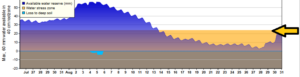
In the graph, RAW is expressed as a function of soil depth (RAW in mm/m × soil depth in m) and is multiplied by a crop-dependent coefficient.
It is represented by an orange line, and the crop coefficient differs between orchards and vineyards:
-
40% of TAW for vineyards
-
50% of TAW for orchards
Above this threshold, water is easily accessible to the crop; below it, water extraction becomes significantly more difficult and water stress begins.
Initial Reserve (mm)
The theoretical initial water reserve at the start of the season:
Initial reserve (mm) =TAW×root depth
Irrigation Type
The irrigation method (full field / micro-sprinkler / drip irrigation).
Irrigation Efficiency
The efficiency of the irrigation system. For example, full-field sprinkler irrigation may be considered only 80% efficient, as not all the applied water reaches the soil.
Explanation of the different parameters
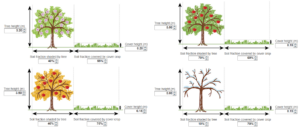
For each season, you must define the following parameters:
Tree / Cover Height
-
Influence on Kd (density coefficient):
As height increases, Kd increases more gradually. Taller trees create more shading, which reduces soil evaporation. -
Influence on Kcb_full
Kcb_full represents the maximum transpiration potential of a fully developed crop under non-water-limiting conditions.
As trees grow taller, their maximum transpiration increases. -
Conclusion:
-
More leaves → higher transpiration
-
More shade → lower soil evaporation, meaning a larger share of total water use comes from tree transpiration.
-
Soil Fraction Shaded by the Tree / Crop
-
Influence on Kd (tree): As the shaded soil fraction increases, the tree Kd increases.
-
Influence on Kd (cover): If a ground cover is present, its Kd also increases with the shaded fraction.
-
Ground cover effect:
A vegetative ground cover adds additional transpiration, which increases Kcb.
Season
-
Influence on Rl (leaf resistance):
Leaf resistance refers to the resistance of plant leaves to water vapor transfer during transpiration (linked to stomatal opening).
Rl changes with the physiological activity of the plant throughout the year. -
Season definitions:
-
Spring: from green tip to 70 days later
-
Summer: from the end of spring to harvest
-
Autumn: from harvest to the beginning of leaf fall
-
Winter: from leaf fall to green tip
-
-
Important:
Don’t forget to set harvest and leaf fall dates.